Navratri 2026: dates
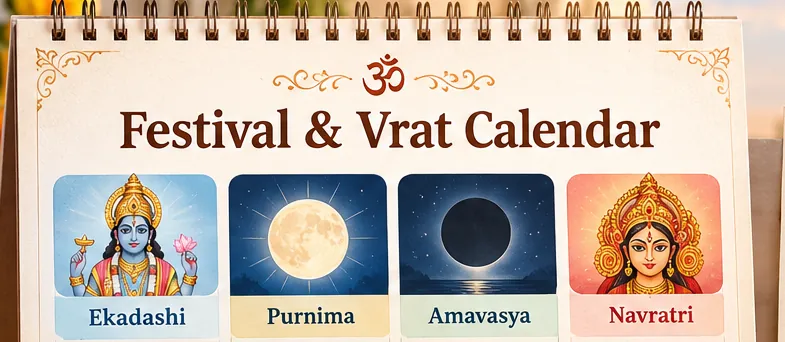
Every festival, Ekadashi, Purnima, Amavasya, Pradosh and Sankranti of the year, worked out for your city — with the exact times each tithi begins and ends.
March 2026
-
Chaitra Navratri begins
Nine nights of the Goddess in spring, beginning with Ghatasthapana.
-
Ram Navami
The birth of Shri Ram, Chaitra Shukla Navami, celebrated at midday.
October 2026
-
Sharad Navratri begins
Nine nights of the Goddess in autumn, beginning with Ghatasthapana.
-
Durga Ashtami
The eighth day of Sharad Navratri.
-
Maha Navami
The ninth day of Sharad Navratri.
-
Dussehra (Vijayadashami)
Ashwin Shukla Dashami, the victory of Ram over Ravana, kept in the afternoon.
Dates and times for New Delhi, India.
A festival can fall on a different day in another city, and more often in another country: the tithi changes at the same instant everywhere, but sunrise does not.
How these dates are worked out: every tithi of the year is found from the Sun's and the Moon's positions (Swiss Ephemeris, Lahiri ayanamsa), with the lunar month it belongs to; adhik months are found the same way. Each festival is kept on the day its tithi is in force at the part of the day tradition names for it — sunrise for most, the evening for Diwali and Pradosh, midnight for Janmashtami and Shivaratri, midday for Ram Navami and Ganesh Chaturthi, the afternoon for Dussehra and Bhai Dooj, moonrise for Karva Chauth and Sankashti. Month names follow the North Indian (purnimanta) calendar; in the amanta calendar used in Gujarat, Maharashtra and the South, the Krishna paksha belongs to the month before.
What this is
This calendar is not copied from a printed list. Every tithi of the year is worked out from the positions of the Sun and the Moon, with the instant it begins and ends, and each festival is placed on the day tradition keeps it: the tithi in force at sunrise for most, in the evening for Diwali, Dhanteras and Pradosh, at midnight for Janmashtami and Shivaratri, at moonrise for Karva Chauth and Sankashti Chaturthi.
Because sunrise and moonrise move with the place, the dates are worked out for your own city. Choose it above; New Delhi is the default. Ekadashi follows the Smarta rule most calendars use; where Vaishnava observance can differ, the entry says so.
Common questions
-
Why is a festival on a different day in my family calendar? Show the answer
Usually because of the place or the rule. A tithi changes at the same moment everywhere, but sunrise does not, so a city far to the east or west can keep it a day apart. Some families also follow a different rule — the Vaishnava Ekadashi, or Bhadra for Raksha Bandhan. The tithi times on each entry show exactly where the day boundary falls.
-
What is an adhik maas? Show the answer
A lunar month in which the Sun does not move into a new sign. It happens about once in three years and keeps the lunar calendar in step with the seasons. Festivals are not kept in it; the Ekadashis of an adhik month have their own names, Padmini and Parama.
-
Is Ekadashi on the day it begins or the next day? Show the answer
On the day the Ekadashi tithi is in force at sunrise. When it is in force at two sunrises, most calendars keep the first; Vaishnava (ISKCON) observance may keep the second.