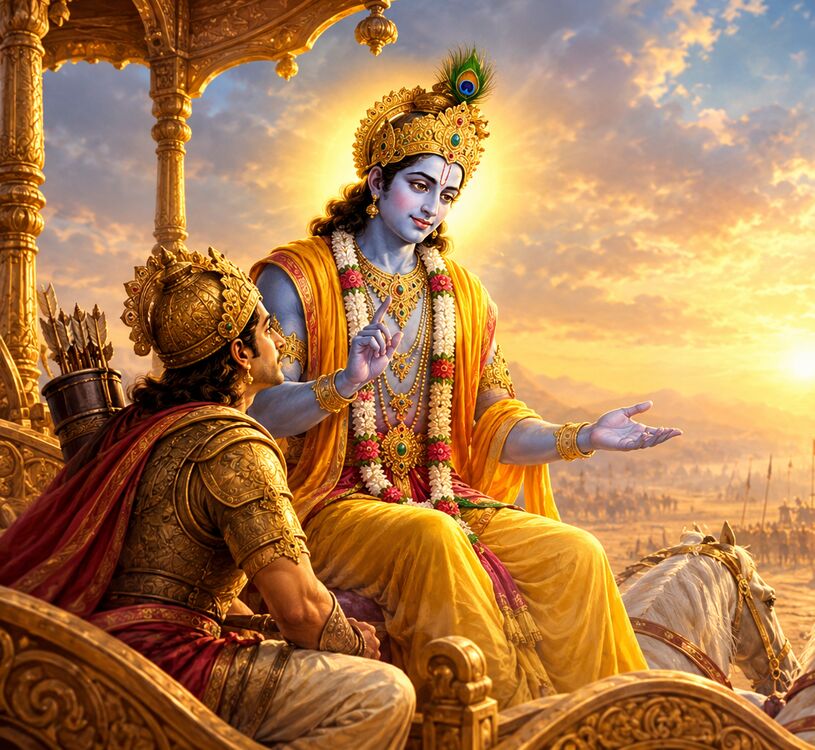


Bhagavad Gita Chapter 18
Moksha Sannyasa Yoga · Freedom through letting go (मोक्षसंन्यासयोग)
Printed from jeevandrishti.com/books/bhagavad-gita/chapter-18, where the meaning of every verse is in English and Hindi.
Duty · Knowledge · Devotion
About Chapter 18, Moksha Sannyasa Yoga
Chapter 18, Moksha Sannyasa Yoga, is the last and longest chapter, and draws the whole Gita together. Arjuna asks the difference between renunciation (sannyasa) and letting go (tyaga); Krishna answers that duties should not be given up, only attachment to them and their fruits (shlokas 1–12). He names the five causes of every action (13–17), and shows how knowledge, action, the doer, understanding, steadiness and even happiness are each of three kinds, by the gunas (18–40).
Everyone reaches perfection by worshipping the Lord through their own work, done according to their nature, and it is better to do one’s own duty imperfectly than another’s well (41–48). Krishna describes how one reaches Brahman and supreme devotion (49–56), and gives his last, most secret word: “Setting aside all duties, take refuge in me alone; I will free you from all wrongs; do not grieve” (57–66). Arjuna says his confusion is gone and he will do as Krishna says, and Sanjaya ends the account: wherever there are Krishna and Arjuna, there are fortune, victory and right conduct (67–78).
A calm reading of all 78 shlokas with their meanings takes about thirty-five minutes.
Renunciation and letting go 18.1–18.12
अर्जुन उवाच Arjuna said
संन्यासस्य महाबाहो तत्त्वमिच्छामि वेदितुम्।
त्यागस्य च हृषीकेश पृथक्केशिनिषूदन॥
Sannyasasya maha-baho tattvam ichchhami veditum
Tyagasya cha hrishikesha prithak keshi-nishudana
हे महाबाहो, हे हृषीकेश, हे केशिनिषूदन, मैं संन्यास और त्याग का तत्त्व अलग-अलग जानना चाहता हूँ।
Mighty-armed one, Hrishikesha, slayer of Keshi, I wish to know the truth about sannyasa (renunciation) and about tyaga (letting go), each separately.
श्रीभगवानुवाच Shri Krishna said
काम्यानां कर्मणां न्यासं संन्यासं कवयो विदुः।
सर्वकर्मफलत्यागं प्राहुस्त्यागं विचक्षणाः॥
Kamyanam karmanam nyasam sannyasam kavayo viduh
Sarva-karma-phala-tyagam prahus tyagam vichakshanah
कुछ ज्ञानी कामना से किए जाने वाले कर्मों के त्याग को संन्यास कहते हैं, और विवेकी लोग सब कर्मों के फल के त्याग को त्याग कहते हैं।
The wise say that giving up actions done out of desire is sannyasa; the discerning say that giving up the fruits of all actions is tyaga.
त्याज्यं दोषवदित्येके कर्म प्राहुर्मनीषिणः।
यज्ञदानतपःकर्म न त्याज्यमिति चापरे॥
Tyajyam dosha-vad ity eke karma prahur manishinah
Yajna-dana-tapah-karma na tyajyam iti chapare
कुछ विद्वान कहते हैं कि कर्म दोषयुक्त है, इसलिए उसे छोड़ देना चाहिए; और दूसरे कहते हैं कि यज्ञ, दान और तप रूपी कर्म नहीं छोड़ने चाहिए।
Some thinkers say all action should be given up as faulty; others say acts of offering, giving and austerity should not be given up.
निश्चयं शृणु मे तत्र त्यागे भरतसत्तम।
त्यागो हि पुरुषव्याघ्र त्रिविधः संप्रकीर्तितः॥
Nishchayam shrinu me tatra tyage bharata-sattama
Tyago hi purusha-vyaghra tri-vidhah samprakirtitah
हे भरतश्रेष्ठ, त्याग के विषय में मेरा निश्चय सुनो। हे पुरुषश्रेष्ठ, त्याग तीन प्रकार का बताया गया है।
Hear my conclusion about letting go, best of the Bharatas. Letting go, tiger among men, is said to be of three kinds.
यज्ञदानतपःकर्म न त्याज्यं कार्यमेव तत्।
यज्ञो दानं तपश्चैव पावनानि मनीषिणाम्॥
Yajna-dana-tapah-karma na tyajyam karyam eva tat
Yajno danam tapash chaiva pavanani manishinam
यज्ञ, दान और तप रूपी कर्म छोड़ने योग्य नहीं हैं, उन्हें करना ही चाहिए; क्योंकि यज्ञ, दान और तप ज्ञानियों को भी पवित्र करते हैं।
Acts of offering, giving and austerity should not be given up; they should be done, for offering, giving and austerity purify even the wise.
एतान्यपि तु कर्माणि सङ्गं त्यक्त्वा फलानि च।
कर्तव्यानीति मे पार्थ निश्चितं मतमुत्तमम्॥
Etany api tu karmani sangam tyaktva phalani cha
Kartavyaniti me partha nishchitam matam uttamam
पर हे पार्थ, ये कर्म भी आसक्ति और फल को छोड़कर करने चाहिए; यह मेरा निश्चित और उत्तम मत है।
But even these should be done giving up attachment and the fruits. This, son of Pritha, is my firm and highest view.
नियतस्य तु संन्यासः कर्मणो नोपपद्यते।
मोहात्तस्य परित्यागस्तामसः परिकीर्तितः॥
Niyatasya tu sannyasah karmano nopapadyate
Mohat tasya parityagas tamasah parikirtitah
नियत कर्म का त्याग उचित नहीं है। मोह के कारण उसे छोड़ देना तामस त्याग कहा गया है।
Giving up one’s prescribed duty is not right. Abandoning it out of confusion is said to be letting go of the tamas kind.
दुःखमित्येव यत्कर्म कायक्लेशभयात्त्यजेत्।
स कृत्वा राजसं त्यागं नैव त्यागफलं लभेत्॥
Duhkham ity eva yat karma kaya-klesha-bhayat tyajet
Sa kritva rajasam tyagam naiva tyaga-phalam labhet
जो कर्म को दुःख रूप समझकर शरीर के कष्ट के डर से छोड़ देता है, वह राजस त्याग करके त्याग का फल नहीं पाता।
One who gives up an action because it is painful, out of fear of bodily strain, makes a letting go of the rajas kind and does not gain its fruit.
कार्यमित्येव यत्कर्म नियतं क्रियतेऽर्जुन।
सङ्गं त्यक्त्वा फलं चैव स त्यागः सात्त्विको मतः॥
Karyam ity eva yat karma niyatam kriyate ’rjuna
Sangam tyaktva phalam chaiva sa tyagah sattviko matah
हे अर्जुन, जब नियत कर्म यह समझकर किया जाता है कि यह करना ही चाहिए, और आसक्ति तथा फल को छोड़ दिया जाता है, तो वह त्याग सात्त्विक माना गया है।
When a prescribed duty is done simply because it ought to be done, Arjuna, giving up attachment and the fruit, that letting go is held to be of sattva.
न द्वेष्ट्यकुशलं कर्म कुशले नानुषज्जते।
त्यागी सत्त्वसमाविष्टो मेधावी छिन्नसंशयः॥
Na dveshty akushalam karma kushale nanushajjate
Tyagi sattva-samavishto medhavi chhinna-sanshayah
सत्त्वगुण से भरा, संशयरहित, बुद्धिमान त्यागी न अप्रिय कर्म से द्वेष करता है, न प्रिय कर्म में आसक्त होता है।
The wise one who lets go, filled with sattva and free of doubt, neither dislikes unpleasant work nor clings to pleasant work.
न हि देहभृता शक्यं त्यक्तुं कर्माण्यशेषतः।
यस्तु कर्मफलत्यागी स त्यागीत्यभिधीयते॥
Na hi deha-bhrita shakyam tyaktum karmany asheshatah
Yas tu karma-phala-tyagi sa tyagity abhidhiyate
देहधारी के लिए सब कर्मों को पूरी तरह छोड़ना संभव नहीं; पर जो कर्मफल का त्याग करता है, वही त्यागी कहलाता है।
It is not possible for an embodied being to give up action entirely; but one who gives up the fruit of action is called one who has truly let go.
अनिष्टमिष्टं मिश्रं च त्रिविधं कर्मणः फलम्।
भवत्यत्यागिनां प्रेत्य न तु संन्यासिनां क्वचित्॥
Anishtam ishtam mishram cha tri-vidham karmanah phalam
Bhavaty atyaginam pretya na tu sannyasinam kvachit
अनिष्ट, इष्ट और मिश्रित, ऐसे तीन प्रकार का कर्मफल त्याग न करने वालों को मृत्यु के बाद मिलता है, पर संन्यासियों को कभी नहीं।
The fruit of action, unwanted, wanted or mixed, comes after death to those who have not let go, but never to those who have renounced.
The five causes of action 18.13–18.17
पञ्चैतानि महाबाहो कारणानि निबोध मे।
सांख्ये कृतान्ते प्रोक्तानि सिद्धये सर्वकर्मणाम्॥
Panchaitani maha-baho karanani nibodha me
Sankhye kritante proktani siddhaye sarva-karmanam
हे महाबाहो, सब कर्मों की सिद्धि के ये पाँच कारण, जो सांख्य सिद्धांत में बताए गए हैं, मुझसे जानो।
Learn from me, mighty-armed one, the five causes for the accomplishment of every action, as taught in the Sankhya teaching.
अधिष्ठानं तथा कर्ता करणं च पृथग्विधम्।
विविधाश्च पृथक्चेष्टा दैवं चैवात्र पञ्चमम्॥
Adhishthanam tatha karta karanam cha prithag-vidham
Vividhash cha prithak cheshta daivam chaivatra panchamam
अधिष्ठान (शरीर), कर्ता, अलग-अलग करण (साधन), अनेक प्रकार की अलग-अलग चेष्टाएँ, और पाँचवाँ दैव।
The body, the doer, the various instruments, the many different efforts, and providence as the fifth.
शरीरवाङ्मनोभिर्यत्कर्म प्रारभते नरः।
न्याय्यं वा विपरीतं वा पञ्चैते तस्य हेतवः॥
Sharira-van-manobhir yat karma prarabhate narah
Nyayyam va viparitam va panchaite tasya hetavah
मनुष्य शरीर, वाणी और मन से जो भी कर्म आरंभ करता है, उचित हो या अनुचित, उसके ये पाँच कारण हैं।
Whatever action a person begins with body, speech or mind, right or wrong, these five are its causes.
तत्रैवं सति कर्तारमात्मानं केवलं तु यः।
पश्यत्यकृतबुद्धित्वान्न स पश्यति दुर्मतिः॥
Tatraivam sati kartaram atmanam kevalam tu yah
Pashyaty akrita-buddhitvan na sa pashyati durmatih
ऐसा होते हुए भी जो अशुद्ध बुद्धि के कारण केवल आत्मा को कर्ता देखता है, वह दुर्बुद्धि ठीक नहीं देखता।
This being so, one who, through an untrained understanding, sees the self alone as the doer does not see; he is mistaken.
यस्य नाहंकृतो भावो बुद्धिर्यस्य न लिप्यते।
हत्वापि स इमाँल्लोकान्न हन्ति न निबध्यते॥
Yasya nahankrito bhavo buddhir yasya na lipyate
Hatva ’pi sa imal lokan na hanti na nibadhyate
जिसमें “मैं कर्ता हूँ” का भाव नहीं है और जिसकी बुद्धि लिप्त नहीं होती, वह इन सब लोगों को मारकर भी न मारता है, न बँधता है।
One who is free of the sense of “I am the doer”, and whose understanding is not stained, does not kill and is not bound, even if he kills these people.
Everything in three kinds 18.18–18.40
ज्ञानं ज्ञेयं परिज्ञाता त्रिविधा कर्मचोदना।
करणं कर्म कर्तेति त्रिविधः कर्मसंग्रहः॥
Jnanam jneyam parijnata tri-vidha karma-chodana
Karanam karma karteti tri-vidhah karma-sangrahah
ज्ञान, ज्ञेय और ज्ञाता, ये तीन कर्म की प्रेरणा हैं; और करण, कर्म और कर्ता, ये तीन कर्म के अंग हैं।
Knowledge, what is known and the knower are the three that prompt action; the instrument, the action and the doer are the three parts of action.
ज्ञानं कर्म च कर्ता च त्रिधैव गुणभेदतः।
प्रोच्यते गुणसंख्याने यथावच्छृणु तान्यपि॥
Jnanam karma cha karta cha tridhaiva guna-bhedatah
Prochyate guna-sankhyane yathavach chhrinu tany api
गुणों के विवेचन में ज्ञान, कर्म और कर्ता, गुणों के भेद से तीन-तीन प्रकार के बताए गए हैं; उन्हें भी ठीक से सुनो।
Knowledge, action and the doer are each of three kinds, by the difference of the gunas, as taught in the study of the gunas. Hear about these too.
सर्वभूतेषु येनैकं भावमव्ययमीक्षते।
अविभक्तं विभक्तेषु तज्ज्ञानं विद्धि सात्त्विकम्॥
Sarva-bhuteshu yenaikam bhavam avyayam ikshate
Avibhaktam vibhakteshu taj jnanam viddhi sattvikam
जिस ज्ञान से व्यक्ति सब प्राणियों में एक अविनाशी भाव को, बँटे हुओं में अविभक्त रूप से देखता है, उस ज्ञान को सात्त्विक जानो।
Knowledge by which one sees one unchanging reality in all beings, undivided in the divided, know that to be of sattva.
पृथक्त्वेन तु यज्ज्ञानं नानाभावान्पृथग्विधान्।
वेत्ति सर्वेषु भूतेषु तज्ज्ञानं विद्धि राजसम्॥
Prithaktvena tu yaj jnanam nana-bhavan prithag-vidhan
Vetti sarveshu bhuteshu taj jnanam viddhi rajasam
जिस ज्ञान से व्यक्ति सब प्राणियों में अलग-अलग अनेक भावों को अलग-अलग ही जानता है, उस ज्ञान को राजस जानो।
Knowledge by which one sees in all beings only many separate natures, each different, know that to be of rajas.
यत्तु कृत्स्नवदेकस्मिन्कार्ये सक्तमहैतुकम्।
अतत्त्वार्थवदल्पं च तत्तामसमुदाहृतम्॥
Yat tu kritsna-vad ekasmin karye saktam ahaitukam
Atattvartha-vad alpam cha tat tamasam udahritam
और जो ज्ञान एक ही कार्य में सब कुछ मानकर आसक्त रहता है, बिना कारण का, तत्त्व को न समझने वाला और तुच्छ है, वह तामस कहा गया है।
And knowledge that clings to one single thing as if it were everything, without reason, without grasping the truth, and narrow, is called of tamas.
नियतं सङ्गरहितमरागद्वेषतः कृतम्।
अफलप्रेप्सुना कर्म यत्तत्सात्त्विकमुच्यते॥
Niyatam sanga-rahitam araga-dveshatah kritam
Aphala-prepsuna karma yat tat sattvikam uchyate
जो कर्म नियत है, आसक्ति से रहित है, राग-द्वेष के बिना किया गया है, और फल न चाहने वाले के द्वारा किया गया है, वह सात्त्विक कहलाता है।
Action that is prescribed, done without attachment, without liking or dislike, by one who does not seek the fruit, is called of sattva.
यत्तु कामेप्सुना कर्म साहङ्कारेण वा पुनः।
क्रियते बहुलायासं तद्राजसमुदाहृतम्॥
Yat tu kamepsuna karma sahankarena va punah
Kriyate bahulayasam tad rajasam udahritam
पर जो कर्म कामनाओं को पूरा करने के लिए, या अहंकार के साथ, और बहुत परिश्रम से किया जाता है, वह राजस कहलाता है।
But action done to satisfy desires, or with ego, and with great strain, is called of rajas.
अनुबन्धं क्षयं हिंसामनपेक्ष्य च पौरुषम्।
मोहादारभ्यते कर्म यत्तत्तामसमुच्यते॥
Anubandham kshayam hinsam anapekshya cha paurusham
Mohad arabhyate karma yat tat tamasam uchyate
जो कर्म परिणाम, हानि, हिंसा और अपने सामर्थ्य का विचार किए बिना, मोह से आरंभ किया जाता है, वह तामस कहलाता है।
Action undertaken out of confusion, without regard to consequences, loss, harm to others or one’s own ability, is called of tamas.
मुक्तसङ्गोऽनहंवादी धृत्युत्साहसमन्वितः।
सिद्ध्यसिद्ध्योर्निर्विकारः कर्ता सात्त्विक उच्यते॥
Mukta-sango ’naham-vadi dhrity-utsaha-samanvitah
Siddhy-asiddhyor nirvikarah karta sattvika uchyate
जो कर्ता आसक्ति से रहित है, अहंकार की बातें नहीं करता, धैर्य और उत्साह से भरा है, और सफलता-असफलता में विकाररहित रहता है, वह सात्त्विक कहलाता है।
A doer who is free of attachment, does not talk of himself, is full of steadiness and enthusiasm, and is unchanged by success or failure, is called of sattva.
रागी कर्मफलप्रेप्सुर्लुब्धो हिंसात्मकोऽशुचिः।
हर्षशोकान्वितः कर्ता राजसः परिकीर्तितः॥
Ragi karma-phala-prepsur lubdho hinsatmako ’shuchih
Harsha-shokanvitah karta rajasah parikirtitah
जो कर्ता आसक्त है, कर्मफल चाहता है, लोभी है, दूसरों को कष्ट देने वाला है, अपवित्र है, और हर्ष-शोक से भरा है, वह राजस कहा गया है।
A doer who is passionate, eager for the fruits of action, greedy, harmful, impure, and swept by joy and grief, is called of rajas.
अयुक्तः प्राकृतः स्तब्धः शठो नैष्कृतिकोऽलसः।
विषादी दीर्घसूत्री च कर्ता तामस उच्यते॥
Ayuktah prakritah stabdhah shatho naishkritiko ’lasah
Vishadi dirgha-sutri cha karta tamasa uchyate
जो कर्ता अयुक्त, असभ्य, हठी, धूर्त, दूसरों का काम बिगाड़ने वाला, आलसी, उदास और टालमटोल करने वाला है, वह तामस कहलाता है।
A doer who is undisciplined, crude, stubborn, deceitful, malicious, lazy, gloomy and given to delay, is called of tamas.
बुद्धेर्भेदं धृतेश्चैव गुणतस्त्रिविधं शृणु।
प्रोच्यमानमशेषेण पृथक्त्वेन धनञ्जय॥
Buddher bhedam dhritesh chaiva gunatas tri-vidham shrinu
Prochyamanam asheshena prithaktvena dhananjaya
हे धनंजय, अब गुणों के अनुसार बुद्धि और धृति के तीन-तीन प्रकार के भेद, पूरी तरह और अलग-अलग कहे जा रहे हैं, सुनो।
Now hear, Dhananjaya, the threefold division of understanding and of steadiness by the gunas, told fully and separately.
प्रवृत्तिं च निवृत्तिं च कार्याकार्ये भयाभये।
बन्धं मोक्षं च या वेत्ति बुद्धिः सा पार्थ सात्त्विकी॥
Pravrittim cha nivrittim cha karyakarye bhayabhaye
Bandham moksham cha ya vetti buddhih sa partha sattviki
हे पार्थ, जो बुद्धि प्रवृत्ति और निवृत्ति को, करने और न करने योग्य को, भय और अभय को, और बंधन और मोक्ष को जानती है, वह सात्त्विकी है।
Understanding that knows when to act and when to refrain, what should and should not be done, what to fear and what not, what binds and what frees, is of sattva, son of Pritha.
यया धर्ममधर्मं च कार्यं चाकार्यमेव च।
अयथावत्प्रजानाति बुद्धिः सा पार्थ राजसी॥
Yaya dharmam adharmam cha karyam chakaryam eva cha
Ayathavat prajanati buddhih sa partha rajasi
हे पार्थ, जिस बुद्धि से मनुष्य धर्म और अधर्म को, तथा करने और न करने योग्य को ठीक से नहीं जानता, वह राजसी है।
Understanding that wrongly judges dharma and adharma, and what should and should not be done, is of rajas, son of Pritha.
अधर्मं धर्ममिति या मन्यते तमसाऽऽवृता।
सर्वार्थान्विपरीतांश्च बुद्धिः सा पार्थ तामसी॥
Adharmam dharmam iti ya manyate tamasavrita
Sarvarthan viparitansh cha buddhih sa partha tamasi
हे पार्थ, जो बुद्धि अंधकार से ढकी होकर अधर्म को धर्म मानती है और सब बातों को उलटा देखती है, वह तामसी है।
Understanding that, covered by darkness, takes adharma for dharma and sees everything upside down, is of tamas, son of Pritha.
धृत्या यया धारयते मनःप्राणेन्द्रियक्रियाः।
योगेनाव्यभिचारिण्या धृतिः सा पार्थ सात्त्विकी॥
Dhritya yaya dharayate manah-pranendriya-kriyah
Yogenavyabhicharinya dhritih sa partha sattviki
हे पार्थ, जिस अटल धृति से मनुष्य योग के द्वारा मन, प्राण और इन्द्रियों की क्रियाओं को धारण करता है, वह सात्त्विकी है।
The unwavering steadiness by which, through yoga, one holds the workings of the mind, the breath and the senses, is of sattva, son of Pritha.
यया तु धर्मकामार्थान् धृत्या धारयतेऽर्जुन।
प्रसङ्गेन फलाकाङ्क्षी धृतिः सा पार्थ राजसी॥
Yaya tu dharma-kamarthan dhritya dharayate ’rjuna
Prasangena phalakankshi dhritih sa partha rajasi
पर हे अर्जुन, जिस धृति से मनुष्य आसक्ति और फल की इच्छा के साथ धर्म, काम और अर्थ को पकड़े रहता है, वह राजसी है।
But the steadiness by which one holds on to duty, pleasure and wealth, wanting their fruits out of attachment, Arjuna, is of rajas.
यया स्वप्नं भयं शोकं विषादं मदमेव च।
न विमुञ्चति दुर्मेधा धृतिः सा पार्थ तामसी॥
Yaya svapnam bhayam shokam vishadam madam eva cha
Na vimunchati durmedha dhritih sa partha tamasi
हे पार्थ, जिस धृति से दुर्बुद्धि मनुष्य नींद, भय, शोक, उदासी और घमंड को नहीं छोड़ता, वह तामसी है।
The steadiness by which a dull person does not let go of sleep, fear, grief, despair and arrogance is of tamas, son of Pritha.
सुखं त्विदानीं त्रिविधं शृणु मे भरतर्षभ।
अभ्यासाद्रमते यत्र दुःखान्तं च निगच्छति॥
Sukham tv idanim tri-vidham shrinu me bharatarshabha abhyasad ramate yatra duhkhantam cha nigachchhati
Yat tad agre visham iva pariname ’mritopamam tat sukham sattvikam proktam atma-buddhi-prasada-jam
हे भरतश्रेष्ठ, अब मुझसे तीन प्रकार के सुख के बारे में सुनो: जिसमें मनुष्य अभ्यास से रमता है और जिससे दुःखों का अंत हो जाता है,
Now hear from me, best of the Bharatas, the three kinds of happiness: that in which one rejoices through practice, and in which sorrow comes to an end,
यत्तदग्रे विषमिव परिणामेऽमृतोपमम्।
तत्सुखं सात्त्विकं प्रोक्तमात्मबुद्धिप्रसादजम्॥
Yat tad agre visham iva pariname ’mritopamam
Tat sukham sattvikam proktam atma-buddhi-prasada-jam
जो आरंभ में विष जैसा पर परिणाम में अमृत जैसा होता है, और अपनी बुद्धि की प्रसन्नता से उत्पन्न होता है, वह सुख सात्त्विक कहा गया है।
that which is like poison at first but like nectar in the end, born of the clarity of one’s own understanding, is called happiness of sattva.
विषयेन्द्रियसंयोगाद्यत्तदग्रेऽमृतोपमम्।
परिणामे विषमिव तत्सुखं राजसं स्मृतम्॥
Vishayendriya-sanyogad yat tad agre ’mritopamam
Pariname visham iva tat sukham rajasam smritam
जो सुख इन्द्रियों और विषयों के संयोग से होता है, जो आरंभ में अमृत जैसा पर परिणाम में विष जैसा है, वह राजस माना गया है।
Happiness from the contact of the senses with their objects, like nectar at first but like poison in the end, is held to be of rajas.
यदग्रे चानुबन्धे च सुखं मोहनमात्मनः।
निद्रालस्यप्रमादोत्थं तत्तामसमुदाहृतम्॥
Yad agre chanubandhe cha sukham mohanam atmanah
Nidralasya-pramadottham tat tamasam udahritam
जो सुख आरंभ में और परिणाम में भी आत्मा को मोहित करता है, और नींद, आलस्य और प्रमाद से उत्पन्न होता है, वह तामस कहा गया है।
Happiness that deludes the self at the beginning and in its result, arising from sleep, laziness and carelessness, is called of tamas.
न तदस्ति पृथिव्यां वा दिवि देवेषु वा पुनः।
सत्त्वं प्रकृतिजैर्मुक्तं यदेभिः स्यात्त्रिभिर्गुणैः॥
Na tad asti prithivyam va divi deveshu va punah
Sattvam prakriti-jair muktam yad ebhih syat tribhir gunaih
पृथ्वी पर, या स्वर्ग में देवताओं में भी, ऐसा कोई प्राणी नहीं जो प्रकृति से उत्पन्न इन तीन गुणों से मुक्त हो।
There is no being on earth, or in heaven among the gods, that is free of these three gunas born of nature.
Work born of one’s nature 18.41–18.48
ब्राह्मणक्षत्रियविशां शूद्राणां च परंतप।
कर्माणि प्रविभक्तानि स्वभावप्रभवैर्गुणैः॥
Brahmana-kshatriya-visham shudranam cha parantapa
Karmani pravibhaktani svabhava-prabhavair gunaih
हे परंतप, ब्राह्मणों, क्षत्रियों, वैश्यों और शूद्रों के कर्म उनके स्वभाव से उत्पन्न गुणों के अनुसार बाँटे गए हैं।
The duties of brahmins, kshatriyas and vaishyas, and of shudras, scorcher of foes, are divided according to the qualities born of their own nature.
शमो दमस्तपः शौचं क्षान्तिरार्जवमेव च।
ज्ञानं विज्ञानमास्तिक्यं ब्रह्मकर्म स्वभावजम्॥
Shamo damas tapah shaucham kshantir arjavam eva cha
Jnanam vijnanam astikyam brahma-karma svabhava-jam
शम, दम, तप, पवित्रता, क्षमा, सरलता, ज्ञान, विज्ञान और आस्तिकता, ये ब्राह्मण के स्वाभाविक कर्म हैं।
Calm, self-control, austerity, purity, patience, honesty, knowledge, realisation and faith are the natural work of the brahmin.
शौर्यं तेजो धृतिर्दाक्ष्यं युद्धे चाप्यपलायनम्।
दानमीश्वरभावश्च क्षात्रं कर्म स्वभावजम्॥
Shauryam tejo dhritir dakshyam yuddhe chapy apalayanam
Danam ishvara-bhavash cha kshatram karma svabhava-jam
शौर्य, तेज, धैर्य, कुशलता, युद्ध से न भागना, दान और नेतृत्व, ये क्षत्रिय के स्वाभाविक कर्म हैं।
Courage, vigour, steadiness, skill, not fleeing from battle, generosity and leadership are the natural work of the kshatriya.
कृषिगौरक्ष्यवाणिज्यं वैश्यकर्म स्वभावजम्।
परिचर्यात्मकं कर्म शूद्रस्यापि स्वभावजम्॥
Krishi-gau-rakshya-vanijyam vaishya-karma svabhava-jam
Paricharyatmakam karma shudrasyapi svabhava-jam
खेती, गौपालन और व्यापार वैश्य के स्वाभाविक कर्म हैं, और सेवा रूप कर्म शूद्र का स्वाभाविक कर्म है।
Farming, caring for cattle and trade are the natural work of the vaishya; work in the form of service is the natural work of the shudra.
स्वे स्वे कर्मण्यभिरतः संसिद्धिं लभते नरः।
स्वकर्मनिरतः सिद्धिं यथा विन्दति तच्छृणु॥
Sve sve karmany abhiratah sansiddhim labhate narah
Sva-karma-niratah siddhim yatha vindati tach chhrinu
अपने-अपने कर्म में लगा हुआ मनुष्य सिद्धि पाता है। अपने कर्म में लगा व्यक्ति सिद्धि कैसे पाता है, वह सुनो।
Each devoted to their own work, people reach perfection. Hear how one devoted to one’s own work finds perfection.
यतः प्रवृत्तिर्भूतानां येन सर्वमिदं ततम्।
स्वकर्मणा तमभ्यर्च्य सिद्धिं विन्दति मानवः॥
Yatah pravrittir bhutanam yena sarvam idam tatam
Sva-karmana tam abhyarchya siddhim vindati manavah
जिससे सब प्राणियों की उत्पत्ति हुई है और जिससे यह सारा संसार व्याप्त है, उस परमात्मा की अपने कर्म से पूजा करके मनुष्य सिद्धि पाता है।
By worshipping, through one’s own work, Him from whom all beings come and by whom all this is pervaded, a person finds perfection.
श्रेयान्स्वधर्मो विगुणः परधर्मात्स्वनुष्ठितात्।
स्वभावनियतं कर्म कुर्वन्नाप्नोति किल्बिषम्॥
Shreyan swa-dharmo vigunah para-dharmat sv-anushthitat
Svabhava-niyatam karma kurvan napnoti kilbisham
अच्छी तरह निभाए गए दूसरे के धर्म से अपना धर्म, गुणों में कम होने पर भी, श्रेष्ठ है। स्वभाव से नियत कर्म करते हुए मनुष्य पाप का भागी नहीं होता।
Better one’s own duty, even done imperfectly, than another’s duty done well. Doing the work suited to one’s nature, one incurs no wrong.
सहजं कर्म कौन्तेय सदोषमपि न त्यजेत्।
सर्वारम्भा हि दोषेण धूमेनाग्निरिवावृताः॥
Saha-jam karma kaunteya sa-dosham api na tyajet
Sarvarambha hi doshena dhumenagnir ivavritah
हे कौन्तेय, अपने सहज कर्म को, दोषयुक्त होने पर भी, नहीं छोड़ना चाहिए; क्योंकि सब कार्य किसी न किसी दोष से वैसे ही ढके हैं जैसे धुएँ से आग।
Son of Kunti, one should not give up the work one is born to, even if it has flaws, for every undertaking is clouded by some flaw, as fire is by smoke.
Reaching Brahman 18.49–18.56
असक्तबुद्धिः सर्वत्र जितात्मा विगतस्पृहः।
नैष्कर्म्यसिद्धिं परमां संन्यासेनाधिगच्छति॥
Asakta-buddhih sarvatra jitatma vigata-sprihah
Naishkarmya-siddhim paramam sannyasenadhigachchhati
जिसकी बुद्धि सब जगह अनासक्त है, जिसने अपने को जीत लिया है और जिसकी लालसा मिट गई है, वह संन्यास के द्वारा नैष्कर्म्य की परम सिद्धि को प्राप्त होता है।
One whose understanding is unattached everywhere, who has mastered the self and is free of longing, reaches through renunciation the supreme perfection of freedom from action.
सिद्धिं प्राप्तो यथा ब्रह्म तथाप्नोति निबोध मे।
समासेनैव कौन्तेय निष्ठा ज्ञानस्य या परा॥
Siddhim prapto yatha brahma tathapnoti nibodha me
Samasenaiva kaunteya nishtha jnanasya ya para
हे कौन्तेय, सिद्धि पाया हुआ मनुष्य ज्ञान की परम निष्ठा, ब्रह्म को कैसे प्राप्त होता है, वह मुझसे संक्षेप में जानो।
Learn from me briefly, son of Kunti, how one who has reached perfection reaches Brahman, the highest state of knowledge.
बुद्ध्या विशुद्धया युक्तो धृत्याऽऽत्मानं नियम्य च।
शब्दादीन् विषयांस्त्यक्त्वा रागद्वेषौ व्युदस्य च॥
Buddhya vishuddhaya yukto dhrityatmanam niyamya cha
Shabdadin vishayans tyaktva raga-dveshau vyudasya cha
शुद्ध बुद्धि से युक्त होकर, धृति से मन को वश में करके, शब्द आदि विषयों को छोड़कर, और राग-द्वेष को हटाकर,
Joined to a pure understanding, controlling oneself with steadiness, turning away from sound and the other sense objects, and setting aside liking and dislike,
विविक्तसेवी लघ्वाशी यतवाक्कायमानसः।
ध्यानयोगपरो नित्यं वैराग्यं समुपाश्रितः॥
Vivikta-sevi laghv-ashi yata-vak-kaya-manasah
Dhyana-yoga-paro nityam vairagyam samupashritah
एकांत में रहने वाला, थोड़ा खाने वाला, वाणी, शरीर और मन को वश में रखने वाला, सदा ध्यान योग में लगा हुआ और वैराग्य का आश्रय लेने वाला,
living in a quiet place, eating lightly, with speech, body and mind controlled, always given to meditation and taking refuge in detachment,
अहङ्कारं बलं दर्पं कामं क्रोधं परिग्रहम्।
विमुच्य निर्ममः शान्तो ब्रह्मभूयाय कल्पते॥
Ahankaram balam darpam kamam krodham parigraham
Vimuchya nirmamah shanto brahma-bhuyaya kalpate
अहंकार, बल, घमंड, काम, क्रोध और संग्रह को छोड़कर, ममता से रहित और शांत व्यक्ति ब्रह्म को प्राप्त होने के योग्य हो जाता है।
giving up ego, force, arrogance, desire, anger and possessiveness, free of “mine” and at peace, one becomes fit to become one with Brahman.
ब्रह्मभूतः प्रसन्नात्मा न शोचति न काङ्क्षति।
समः सर्वेषु भूतेषु मद्भक्तिं लभते पराम्॥
Brahma-bhutah prasannatma na shochati na kankshati
Samah sarveshu bhuteshu mad-bhaktim labhate param
ब्रह्मरूप हुआ, प्रसन्न मन वाला व्यक्ति न शोक करता है, न कामना करता है; सब प्राणियों में समान भाव रखकर वह मेरी परम भक्ति पाता है।
Become one with Brahman and serene within, one neither grieves nor craves. Even-minded towards all beings, one gains supreme devotion to me.
भक्त्या मामभिजानाति यावान्यश्चास्मि तत्त्वतः।
ततो मां तत्त्वतो ज्ञात्वा विशते तदनन्तरम्॥
Bhaktya mam abhijanati yavan yash chasmi tattvatah
Tato mam tattvato jnatva vishate tad-anantaram
भक्ति से वह मुझे तत्त्व से जानता है कि मैं कौन हूँ और कितना हूँ; और मुझे तत्त्व से जानकर फिर मुझमें प्रवेश कर जाता है।
Through devotion one comes to know me truly, what and who I am; and knowing me truly, one then enters into me.
सर्वकर्माण्यपि सदा कुर्वाणो मद्व्यपाश्रयः।
मत्प्रसादादवाप्नोति शाश्वतं पदमव्ययम्॥
Sarva-karmany api sada kurvano mad-vyapashrayah
Mat-prasadad avapnoti shashvatam padam avyayam
मेरी शरण लेने वाला सदा सब प्रकार के कर्म करता हुआ भी मेरी कृपा से सनातन, अविनाशी पद को प्राप्त होता है।
Even while always doing all kinds of actions, one who takes refuge in me reaches, by my grace, the eternal, unchanging abode.
Take refuge in me 18.57–18.66
चेतसा सर्वकर्माणि मयि संन्यस्य मत्परः।
बुद्धियोगमुपाश्रित्य मच्चित्तः सततं भव॥
Chetasa sarva-karmani mayi sannyasya mat-parah
Buddhi-yogam upashritya mach-chittah satatam bhava
मन से सब कर्म मुझे अर्पित करके, मुझे परम लक्ष्य मानकर, बुद्धियोग का सहारा लेकर, सदा मुझमें मन लगाए रहो।
Mentally offering all actions to me, holding me as your goal, relying on the yoga of understanding, keep your mind always on me.
मच्चित्तः सर्वदुर्गाणि मत्प्रसादात्तरिष्यसि।
अथ चेत्त्वमहङ्कारान्न श्रोष्यसि विनङ्क्ष्यसि॥
Mach-chittah sarva-durgani mat-prasadat tarishyasi
Atha chet tvam ahankaran na shroshyasi vinankshyasi
मुझमें मन लगाकर तुम मेरी कृपा से सब कठिनाइयों को पार कर जाओगे; पर यदि अहंकार के कारण मेरी बात नहीं सुनोगे, तो नष्ट हो जाओगे।
With your mind on me, you will cross all difficulties by my grace. But if, out of ego, you will not listen, you will be lost.
यदहङ्कारमाश्रित्य न योत्स्य इति मन्यसे।
मिथ्यैष व्यवसायस्ते प्रकृतिस्त्वां नियोक्ष्यति॥
Yad ahankaram ashritya na yotsya iti manyase
Mithyaisha vyavasayas te prakritis tvam niyokshyati
यदि अहंकार का सहारा लेकर तुम सोचते हो कि “मैं युद्ध नहीं करूँगा”, तो तुम्हारा यह निश्चय व्यर्थ है; तुम्हारा स्वभाव तुम्हें युद्ध में लगा देगा।
If, relying on ego, you think, “I will not fight,” your resolve is in vain; your own nature will compel you.
स्वभावजेन कौन्तेय निबद्धः स्वेन कर्मणा।
कर्तुं नेच्छसि यन्मोहात्करिष्यस्यवशोऽपि तत्॥
Swbhava-jena kaunteya nibaddhah svena karmana
Kartum nechchhasi yan mohat karishyasy avasho ’pi tat
हे कौन्तेय, अपने स्वभाव से उत्पन्न कर्म से बँधे होने के कारण, जो काम तुम मोह से नहीं करना चाहते, वह विवश होकर भी करोगे।
Bound by your own work born of your nature, son of Kunti, what you do not wish to do out of confusion, you will do even against your will.
ईश्वरः सर्वभूतानां हृद्देशेऽर्जुन तिष्ठति।
भ्रामयन्सर्वभूतानि यन्त्रारूढानि मायया॥
Ishvarah sarva-bhutanam hrid-deshe ’rjuna tishthati
Bhramayan sarva-bhutani yantrarudhani mayaya
हे अर्जुन, ईश्वर सब प्राणियों के हृदय में रहता है, और अपनी माया से सब प्राणियों को ऐसे घुमाता है मानो वे किसी यंत्र पर चढ़े हों।
The Lord dwells in the heart of all beings, Arjuna, moving all beings by his power, as if they were mounted on a machine.
तमेव शरणं गच्छ सर्वभावेन भारत।
तत्प्रसादात्परां शान्तिं स्थानं प्राप्स्यसि शाश्वतम्॥
Tam eva sharanam gachchha sarva-bhavena bharata
Tat-prasadat param shantim sthanam prapsyasi shashvatam
हे भारत, पूरे भाव से उसी की शरण में जाओ; उसकी कृपा से तुम परम शांति और सनातन धाम पाओगे।
Take refuge in him alone with your whole being, Bharata. By his grace you will reach supreme peace and the eternal abode.
इति ते ज्ञानमाख्यातं गुह्याद्गुह्यतरं मया।
विमृश्यैतदशेषेण यथेच्छसि तथा कुरु॥
Iti te jnanam akhyatam guhyad guhyataram maya
Vimrishyaitad asheshena yathechchhasi tatha kuru
इस प्रकार मैंने तुम्हें गोपनीय से भी अधिक गोपनीय ज्ञान बताया है। इस पर पूरी तरह विचार करके, फिर जैसा चाहो वैसा करो।
So I have told you knowledge more secret than all secrets. Reflect on it fully, and then do as you wish.
सर्वगुह्यतमं भूयः शृणु मे परमं वचः।
इष्टोऽसि मे दृढमिति ततो वक्ष्यामि ते हितम्॥
Sarva-guhyatamam bhuyah shrinu me paramam vachah
Ishto ’si me dridham iti tato vakshyami te hitam
सबसे गोपनीय मेरा परम वचन फिर से सुनो। तुम मुझे बहुत प्रिय हो, इसलिए मैं तुम्हारे हित की बात कहूँगा।
Hear again my supreme word, the most secret of all. You are dearly loved by me, so I will tell you what is good for you.
मन्मना भव मद्भक्तो मद्याजी मां नमस्कुरु।
मामेवैष्यसि सत्यं ते प्रतिजाने प्रियोऽसि मे॥
Man-mana bhava mad-bhakto mad-yaji mam namaskuru
Mam evaishyasi satyam te pratijane priyo ’si me
मुझमें मन लगाओ, मेरे भक्त बनो, मेरी पूजा करो और मुझे प्रणाम करो; तुम मुझे ही प्राप्त होगे, यह मैं तुमसे सच्ची प्रतिज्ञा करता हूँ, क्योंकि तुम मुझे प्रिय हो।
Fix your mind on me, be devoted to me, worship me and bow to me. You will come to me; I promise you this truly, for you are dear to me.
सर्वधर्मान्परित्यज्य मामेकं शरणं व्रज।
अहं त्वा सर्वपापेभ्यो मोक्षयिष्यामि मा शुचः॥
Sarva-dharman parityajya mam ekam sharanam vraja
Aham tvam sarva-papebhyo mokshayishyami ma shuchah
सब धर्मों को छोड़कर केवल मेरी शरण में आ जाओ। मैं तुम्हें सब पापों से मुक्त कर दूँगा, शोक मत करो।
Setting aside all duties, take refuge in me alone. I will free you from all wrongs; do not grieve.
The end of the conversation 18.67–18.78
इदं ते नातपस्काय नाभक्ताय कदाचन।
न चाशुश्रूषवे वाच्यं न च मां योऽभ्यसूयति॥
Idam te natapaskyaya nabhaktaya kadachana
Na chashushrushave vachyam na cha mam yo ’bhyasutayi
यह ज्ञान कभी भी तप रहित को, भक्ति रहित को, सुनना न चाहने वाले को, और मुझमें दोष देखने वाले को नहीं कहना चाहिए।
This should never be told to one without discipline, to one without devotion, to one who does not wish to listen, or to one who finds fault with me.
य इमं परमं गुह्यं मद्भक्तेष्वभिधास्यति।
भक्तिं मयि परां कृत्वा मामेवैष्यत्यसंशयः॥
Ya idam paramam guhyam mad-bhakteshv abhidhasyati
Bhaktim mayi param kritva mam evaishyaty asanshayah
जो मुझमें परम भक्ति रखकर यह परम गोपनीय ज्ञान मेरे भक्तों को सुनाएगा, वह निःसंदेह मुझे ही प्राप्त होगा।
One who, with supreme devotion to me, teaches this supreme secret to my devotees will surely come to me.
न च तस्मान्मनुष्येषु कश्चिन्मे प्रियकृत्तमः।
भविता न च मे तस्मादन्यः प्रियतरो भुवि॥
Na cha tasman manushyeshu kashchin me priya-krittamah
Bhavita na cha me tasmad anyah priyataro bhuvi
मनुष्यों में उससे बढ़कर मुझे प्रिय काम करने वाला कोई नहीं, और न पृथ्वी पर उससे बढ़कर मुझे कोई प्रिय होगा।
No one among people does more to please me than such a person, and no one on earth will be dearer to me.
अध्येष्यते च य इमं धर्म्यं संवादमावयोः।
ज्ञानयज्ञेन तेनाहमिष्टः स्यामिति मे मतिः॥
Adhyeshyate cha ya imam dharmyam samvadam avayoh
Jnana-yajnena tenaham ishtah syam iti me matih
और जो हमारे इस धर्ममय संवाद का अध्ययन करेगा, उसके द्वारा मैं ज्ञान यज्ञ से पूजा जाऊँगा, ऐसा मेरा मत है।
And one who studies this sacred conversation of ours worships me, I believe, with the offering of knowledge.
श्रद्धावाननसूयश्च शृणुयादपि यो नरः।
सोऽपि मुक्तः शुभाँल्लोकान्प्राप्नुयात्पुण्यकर्मणाम्॥
Shraddhavan anasuyash cha shrinuyad api yo narah
So ’pi muktah shubhal lokan prapnuyat punya-karmanam
और जो मनुष्य श्रद्धा के साथ, दोष देखे बिना इसे केवल सुनेगा भी, वह भी मुक्त होकर पुण्यवानों के शुभ लोकों को प्राप्त होगा।
And even one who just listens to it with faith and without finding fault will be freed, and will reach the happy worlds of those who do good.
कच्चिदेतच्छ्रुतं पार्थ त्वयैकाग्रेण चेतसा।
कच्चिदज्ञानसंमोहः प्रनष्टस्ते धनञ्जय॥
Kachchid etach chhrutam partha tvayaikagrena chetasa
Kachchid ajnana-sammohah pranashtas te dhananjaya
हे पार्थ, क्या तुमने इसे एकाग्र मन से सुना? हे धनंजय, क्या तुम्हारा अज्ञान से उत्पन्न मोह नष्ट हुआ?
Son of Pritha, have you heard this with a focused mind? Dhananjaya, has your confusion born of ignorance been destroyed?
अर्जुन उवाच Arjuna said
नष्टो मोहः स्मृतिर्लब्धा त्वत्प्रसादान्मयाच्युत।
स्थितोऽस्मि गतसन्देहः करिष्ये वचनं तव॥
Nashto mohah smritir labdha tvat-prasadan mayachyuta
Sthito ’smi gata-sandehah karishye vachanam tava
हे अच्युत, आपकी कृपा से मेरा मोह नष्ट हो गया और मुझे स्मृति मिल गई है। मैं संशयरहित होकर स्थित हूँ, और आपकी आज्ञा का पालन करूँगा।
My confusion is gone, and by your grace I have regained my memory, Achyuta. I stand firm, my doubts are gone; I will do as you say.
सञ्जय उवाच Sanjaya said
इत्यहं वासुदेवस्य पार्थस्य च महात्मनः।
संवादमिममश्रौषमद्भुतं रोमहर्षणम्॥
Ity aham vasudevasya parthasya cha mahatmanah
Samvadam imam ashrausham adbhutam roma-harshanam
इस प्रकार मैंने वासुदेव और महात्मा अर्जुन का यह अद्भुत और रोमांचित करने वाला संवाद सुना।
Thus I heard this wonderful conversation between Vasudeva and the great-souled son of Pritha, which makes my hair stand on end.
व्यासप्रसादाच्छ्रुतवानेतद्गुह्यमहं परम्।
योगं योगेश्वरात्कृष्णात्साक्षात्कथयतः स्वयम्॥
Vyasa-prasadach chhrutavan etad guhyam aham param
Yogam yogeshvarat krishnat sakshat kathayatah svayam
व्यासजी की कृपा से मैंने यह परम गोपनीय योग स्वयं योगेश्वर श्रीकृष्ण के मुख से कहते हुए सीधे सुना।
By the grace of Vyasa I heard this supreme secret yoga directly from Krishna, the Lord of yoga, as he spoke it himself.
राजन्संस्मृत्य संस्मृत्य संवादमिममद्भुतम्।
केशवार्जुनयोः पुण्यं हृष्यामि च मुहुर्मुहुः॥
Rajan sansmritya sansmritya samvadam imam adbhutam
Keshavarjunayoh punyam hrishyami cha muhur muhuh
हे राजन, केशव और अर्जुन के इस अद्भुत और पवित्र संवाद को बार-बार याद करके मैं बार-बार हर्षित हो रहा हूँ।
O King, as I remember again and again this wonderful and holy conversation between Keshava and Arjuna, I rejoice again and again.
तच्च संस्मृत्य संस्मृत्य रूपमत्यद्भुतं हरेः।
विस्मयो मे महान् राजन् हृष्यामि च पुनः पुनः॥
Tach cha sansmritya samsmritya rupam aty-adbhutam hareh
Vismayo ye mahan rajan hrishyami cha punah punah
और हे राजन, श्रीहरि के उस अत्यंत अद्भुत रूप को बार-बार याद करके मुझे बड़ा आश्चर्य होता है और मैं बार-बार हर्षित होता हूँ।
And as I remember again and again that most wonderful form of Hari, great is my amazement, O King, and I rejoice again and again.
यत्र योगेश्वरः कृष्णो यत्र पार्थो धनुर्धरः।
तत्र श्रीर्विजयो भूतिर्ध्रुवा नीतिर्मतिर्मम॥
Yatra yogeshvarah krishno yatra partho dhanur-dharah
Tatra shrir vijayo bhutir dhruva nitir matir mama
जहाँ योगेश्वर श्रीकृष्ण हैं और जहाँ धनुर्धर अर्जुन हैं, वहीं श्री, विजय, विभूति और अटल नीति है, ऐसा मेरा मत है।
Wherever there is Krishna, the Lord of yoga, and wherever there is Arjuna, the archer, there, I believe, are fortune, victory, prosperity and lasting right conduct.
ॐ तत्सदिति श्रीमद्भगवद्गीतासूपनिषत्सु ब्रह्मविद्यायां योगशास्त्रे श्रीकृष्णार्जुनसंवादे
मोक्षसंन्यासयोगो नाम अष्टादशोऽध्यायः ॥१८॥
The meanings here are written in plain words and follow the common reading of each shloka; they are not a word-for-word translation or a commentary. The Roman lettering is simplified for easy reading. This page is for reading and reflection; it is not a substitute for medical or other professional help.
Questions people ask
What is Chapter 18 of the Bhagavad Gita about?
The difference between renunciation and letting go, the five causes of action, the three kinds of knowledge, action, doer, understanding, steadiness and happiness, doing one’s own duty, and Krishna’s final teaching of surrender.
What does shloka 18.66 say?
“Sarva-dharman parityajya”: setting aside all duties, take refuge in me alone. I will free you from all wrongs; do not grieve.
What is the difference between sannyasa and tyaga?
Sannyasa is giving up actions done out of desire; tyaga is giving up the fruits of all actions. Krishna says duties should be done, letting go of attachment and fruits (18.2–18.9).
What does Arjuna say at the end of the Gita?
That his confusion is gone and his memory regained by Krishna’s grace; he stands firm, free of doubt, and will do as Krishna says (18.73).
What is the last shloka of the Bhagavad Gita?
“Yatra yogeshvarah krishno”: wherever there is Krishna, the Lord of yoga, and wherever there is Arjuna, the archer, there are fortune, victory, prosperity and lasting right conduct (18.78).
Join us on Facebook
New books and chapters, festival days and easy-to-read astrology, in your feed. Free, and you can leave any time.